
Fantasy Football Takeaways: Ashton Jeanty & Packers WRs Lead Week 2 Utilization Report
Dwain McFarland debuts the first Utilization Report of the 2026 season, covering Ashton Jeanty's Week 1 outburst, a new-look role for Dalton Kincaid, the Packers WR splits and more.
Welcome to the Utilization Report, where Dwain McFarland highlights his top fantasy football takeaways heading into Week 2.
The Top Fantasy Football Takeaways for Week 2
Let's follow the data to identify the top waiver wire options, trade targets, upgrades, and downgrades based on what we learned in Week 1.
If you love the sweet Utilization data below, you can access it all for yourself!
- Comparison tool
- Team-based views with game logs
- League-wide views for NFL leaders
- Customizable time periods and sample sizes
- Seasons: 2020 to 2026
Get 20% off a Tier 2 FantasyLife+ subscription by using code: UR20.
Use the Utilization Report suite of tools to dominate your league, y'all!
 1. Ashton Jeanty ascends to high-end RB1 status in fantasy.
A prayer circle can work wonders. Jeanty tied Bijan Robinson for the No. 1 Utilization Score at RB in Week 1, clocking in with a 99. The second-year back scored 32.7 fantasy points as the RB3 and dominated the Vegas backfield.
Jeanty accounted for 73% of snaps, 70% of rushing attempts, and parlayed his 61% route share into a 21% target share, catching two TDs.
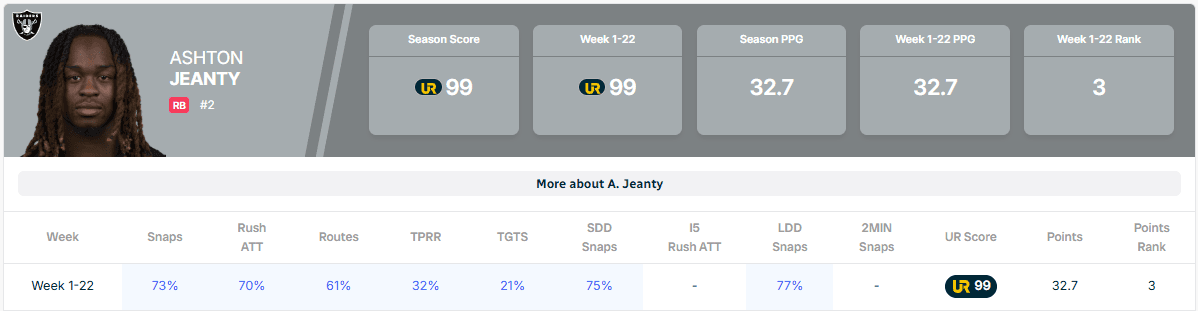
The Round 1 NFL Draft pick finished the day with 23 attempts and 6 targets. He converted those opportunities into 156 yards from scrimmage.
Last season, Jeanty rarely had room to operate, but things looked better behind a revamped offensive line with Tyler Linderbaum and the return of Kolton Miller.
- Yards before contact: 0.5 → 1.0
- Yards after contact: 3.1 → 3.4
- 10+ yard attempts: 9.7% → 13%
It's a small sample, and the Dolphins might not be a good defense, but Jeanty is a top-three RB prospect in the history of the Rookie Super Model, behind only Saquon Barkley and Christian McCaffrey. So, this could also be the norm for Jeanty in 2026.
We could see the Raiders offense regress against tougher competition, but with a new scheme under Klint Kubiak and Jeanty looking more spry than last year, I am bullish on his rest-of-season outlook. And history is on our side.
Since 2013, we have seen 13 RBs post a rush share of 65% or higher with a target share between 16 and 22%. They averaged 23.1 points per game.
Jeanty UPGRADES to high-end RB1 territory as an every-down player.
2. Murky Backfields: What did we learn in Week 1 of the NFL season?
Coming out of the preseason, we lacked clarity on multiple backfield pecking orders and how playing time would divvy up. Let's take another look now that we have one week of data.
Houston Texans
Reports out of training camp suggested a 50-50 backfield split for the Texans, which came to fruition. But David Montgomery was the clear-cut RB1 on the ground with 65% of the attempts, which held despite a shootout game script with the Bills. Monty got all of the attempts inside the five-yard line and 58% of the short-yardage attempts, while Woody Marks played all 14 of the two-minute offense snaps.
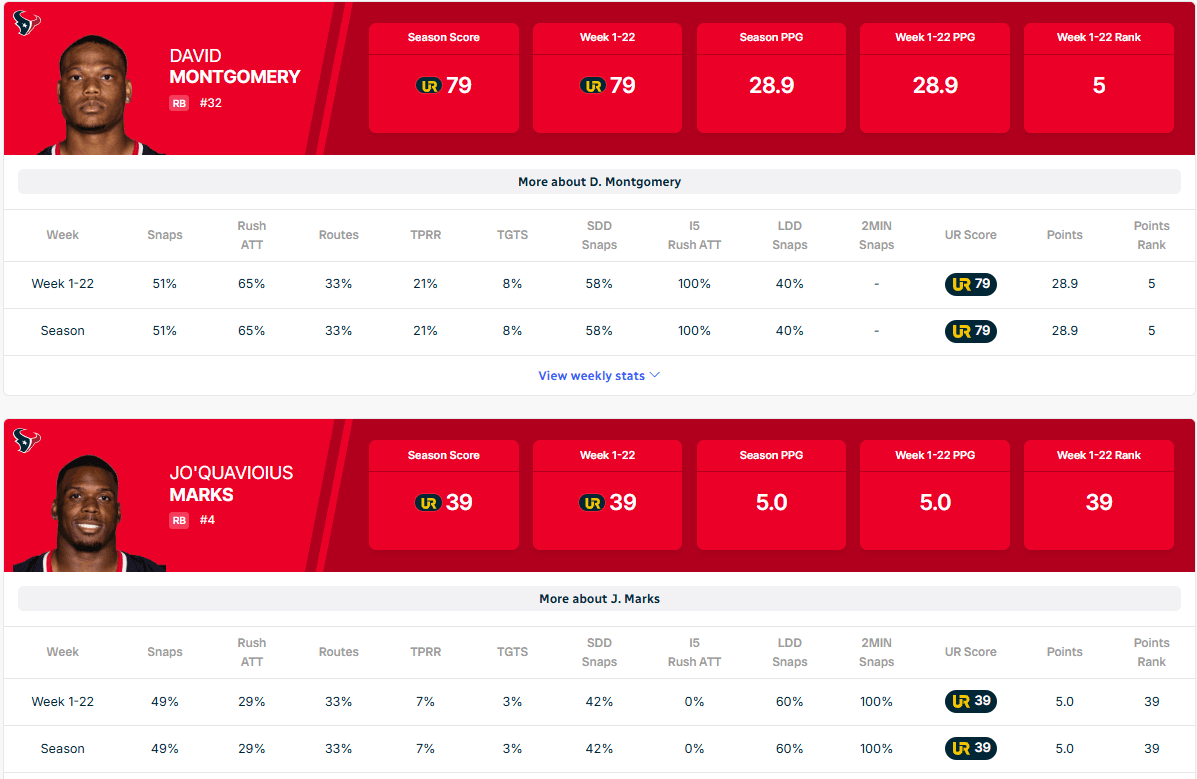
Montgomery finished with 28.9 fantasy points thanks to two rushing TDs and one receiving TD. However, he averaged only 3 yards per carry against a Bills defense that historically has been a plus matchup for RBs. He added three targets in the passing game, finishing with an 8% target share. Historically, RBs with a 79 Utilization Score have averaged 15.4 PPG, with 42% finishing inside the top 12.
- RB1 to RB6 seasons: 15%
- RB7 to RB12 seasons: 27%
- RB13 to RB18 seasons: 37%
- RB19 to RB24 seasons: 17%
Most of his comparisons, based on the last six years of data, fell in the low-end RB1 to high-end RB2 buckets.
Montgomery UPGRADES from low-end RB2 territory to high-end RB2 status. Marks is a borderline RB4 with contingent upside.
New Orleans Saints
Wait. Are the Saints a murky backfield? With the team recently paying Travis Etienne to be their lead back? Well, that is how Week 1 played out, casting doubt on the value of Etienne moving forward.
The Saints opted for a three-way backfield despite Alvin Kamara—who might return in Week 2—not playing. Etienne played 58% of the snaps, but handled only 43% of the attempts and registered a lowly 38% route participation rate.

Etienne ended up squeaking out 14.8 fantasy points, but his efforts were dramatically boosted by the Saints running the most plays in Week 1 by a large margin at 86. His 16% target share was a plus, and he played 68% of the two-minute offense, but that could be Kamara's specialty upon his return.
The newly added free agent was efficient with 4.7 yards per carry (YPC), and 20% of his attempts went for 10-plus yards. So, we could see a rebound, but the Week 1 Utilization definitely has my antennae up.
Etienne DOWNGRADES to low-end RB2 status for now. We will check back on things next week.
Tampa Bay Buccaneers
The Buccaneers added Kenny Gainwell this offseason, and reports from camp indicated that he was hogging passing-down reps, casting doubt on the viability of Bucky Irving as a target in drafts. Irving fell from Round 3 to Round 5 after the signing.
But Irving held a sizeable advantage over Gainwell in Week 1, handling 62% of the snaps and a 58% route participation rate. He even stayed on the field in long-down-and-distance (LDD) situations, handling 75% of those reps.
Irving led the team with 53% of the rushing attempts in a game script where the Bucs fell behind early due to turnovers against the Bengals. He also accounted for 3 of 5 short-yardage snaps, which correlates with attempts inside the five-yard line, which the Bucs never had.
Irving finished the game with 20.3 fantasy points and an 85 Utilization Score—well above that of David Montgomery above, who scored more fantasy points.

One-week samples are always tricky, but this is a positive step for Irving. Historically, RBs with an 85 Utilization Score have fared well, averaging 16.4 points. We have seen 63% secure top-12 finishes.
I am not ready to go that far on Irving after one game, but we saw that sort of upside in his rookie season, so it is on the table.
Irving UPGRADES to mid-range RB2 territory. Gainwell is HOLDING STEADY as a mid-range RB4 option.
New York Giants
With Cam Skattebo coming off a devastating injury from last year and the addition of Najee Harris, fantasy managers grew concerned about this backfield split. However, in Week 1, Skattebo led the way with a 61% snap share and 58% of the rushing attempts.
He handled all of the short-yardage work, including both of the team's attempts inside the five-yard line. While Skattebo's short-yardage ability is a big plus, his other superpower is his receiving. As a rookie, he had a 15% target share and a 54% route share in six full games as the starter.
Unfortunately, Skattebo's passing-game work took a hit in the season's first game, with a 38% route share and a 0% target share. Instead, Devin Singletary handled 50% of the routes and had a 14% target share.
Skattebo finished Week 1 with 14.1 points and a 62 Utilization Score, which was dampened by his lack of work in the passing game. Historically, that score has averaged 12.6 PPG with 49% finishing as borderline RB2s.
The second-year back undoubtedly won't finish with a 0% target share in every game, so I am slightly less concerned about the Utilization Score. The 61% snap share is still a plus, and he has the skill set to grow into a larger role.
Skattebo DOWNGRADES to low-end RB2 status, but his role could grow as the season progresses.
Arizona Cardinals
With Jeremiyah Love coming off a high ankle sprain from Week 1 of the preseason, Tyler Allgeier handled 57% of the snaps and led the backfield in rushing attempts with 57%. The two split short-yardage work, with Love finding the end zone.
Love played 44% of the snaps and handled 37% of the attempts. He also held a slight edge in routes (38% vs. 36%), and his 20% TPRR dwarfed Allgeier's 14%. The rookie scored 13 fantasy points in Week 1 with a 59 Utilization Score.
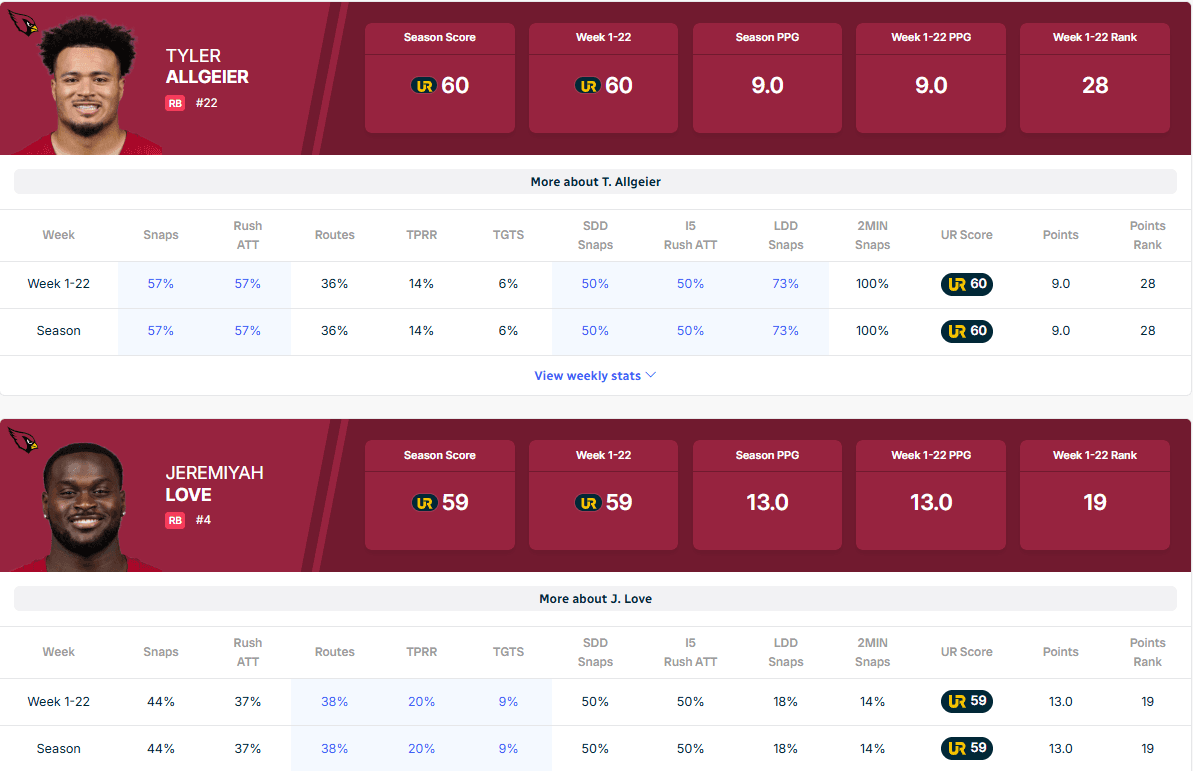
It isn't uncommon for rookies to start slow when a team has a solid RB already on the roster, as in Arizona. However, I expect Love to move into the lead role on this offense eventually. Love is the No. 5 RB prospect in the history of the Rookie Super Model.
Love is a low-end RB in the short term but offers borderline RB1 upside as the season progresses.
Jacksonville Jaguars
Tuten led a committee approach for the Jaguars in Week 1. He led the team in snaps (48%) and attempts (54%). He finished the day with 9.8 points as the RB26.
Chris Rodriguez operated as the lead short-yardage back, which matches preseason reports. And Tuten had a lackluster route share of 32%.
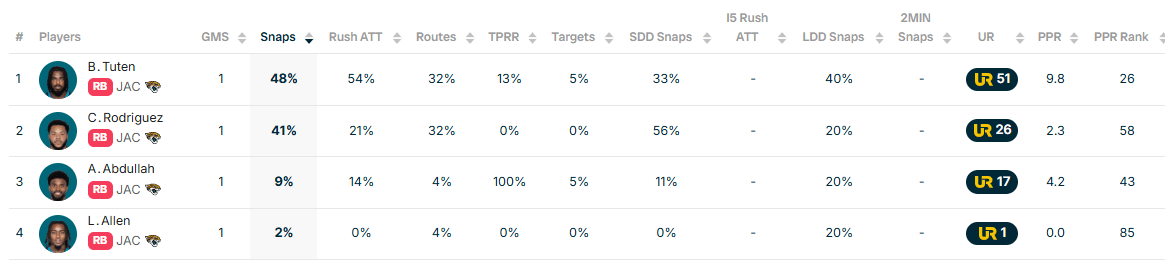
Tuten's 15 attempts in Week 1 look great on the surface, but it was in a massive leading game script where the Jaguars ran the ball on 55% of plays—the second most in Week 1. So, that might be his ceiling for attempts in the current iteration of this offense. In closer games, the number is probably closer to 12, and in trailing scripts it could be 8 or 9.
Ultimately, Tuten finished the day with a 51 Utilization Score. Historically, RBs with that score have averaged 9.3 PPG, with the majority finishing as RB3s and RB4s. Only 6% reached low-end RB2 status.
The bet with Tuten is less about his Week 1 role and more about whether he can expand his Utilization as the season progresses.
Tuten DOWNGRADES to mid-range RB3 territory based on his current role but offers RB1 upside should he ever find himself as the clear-cut lead option for this explosive offense.
Seattle Seahawks
Jadarian Price led the Seahawks backfield in Week 1, but at 50% he was more of the lead committee option than the clear-cut RB1. The Round 1 NFL Draft pick also led the team in route participation at 41% and had an 8% target share.
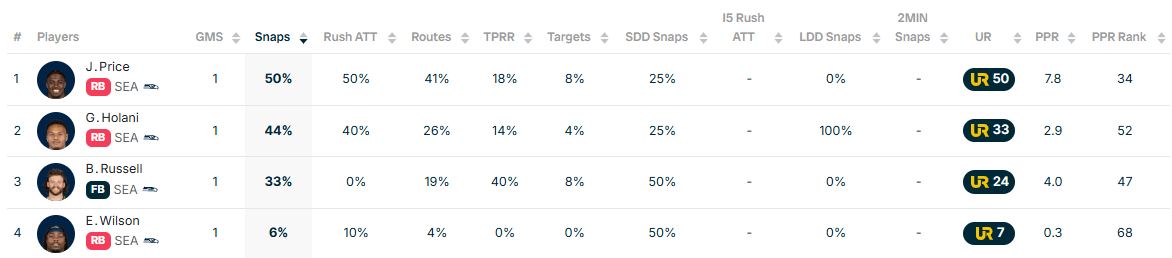
Price was clearly the most explosive player of this group, averaging 5.2 YPC with 20% of his totes going for 10+ yards. He also was the most targeted RB on a TPRR basis at 18%.
While George Holani forced a timeshare in Week 1, there is a chance the Seahawks shift more of the workload to their draft pick. Last year, we didn't see them do that with Kenneth Walker or Zach Charbonnet, but they were on more equal footing with Round 2 draft capital.
Historically, backs selected in this range of the NFL Draft have improved their fantasy output by 70% from Weeks 1-2 vs. the rest of the season.
Price is a mid-range RB3 in the immediate future, but his rest-of-season outlook is a low-end RB2 with upside until Charbonnet returns.
Green Bay Packers
With Josh Jacobs on the Commissioner's exempt list, we saw a dual-headed backfield from the Packers in Week 1.
MarShawn Lloyd led the team with a 62% rush share, handling half of the short-yardage opportunities. But Chris Brooks led the team with a 55% snap share but handled only 33% of the carries.

Lloyd only ran a route on 15% of plays, but Brooks was at 22%. Both backs had to stay in to block, with the Packers giving up a 54% pressure rate. Brooks was ultimately the preferred passing-down back, handling 15 of 20 snaps in the two-minute offense, which swung things in his favor in the snaps department. He is the preferred blocker.
With the Packers' offensive line woes, Lloyd's immediate outlook is murkier than it was ahead of Week 1. The team may be forced to play Brooks if they don't trust Lloyd in pass protection.
Lloyd DOWNGRADES to mid-range RB3 status as long as the offensive line continues to struggle.
Pittsburgh Steelers
Jaylen Warren scored 10.3 points on kickoff weekend, leading the team with 56% of the rushing attempts. But this is a tight rotation—Rico Dowdle led in snaps (58% to 36%) and routes (57% to 31%).
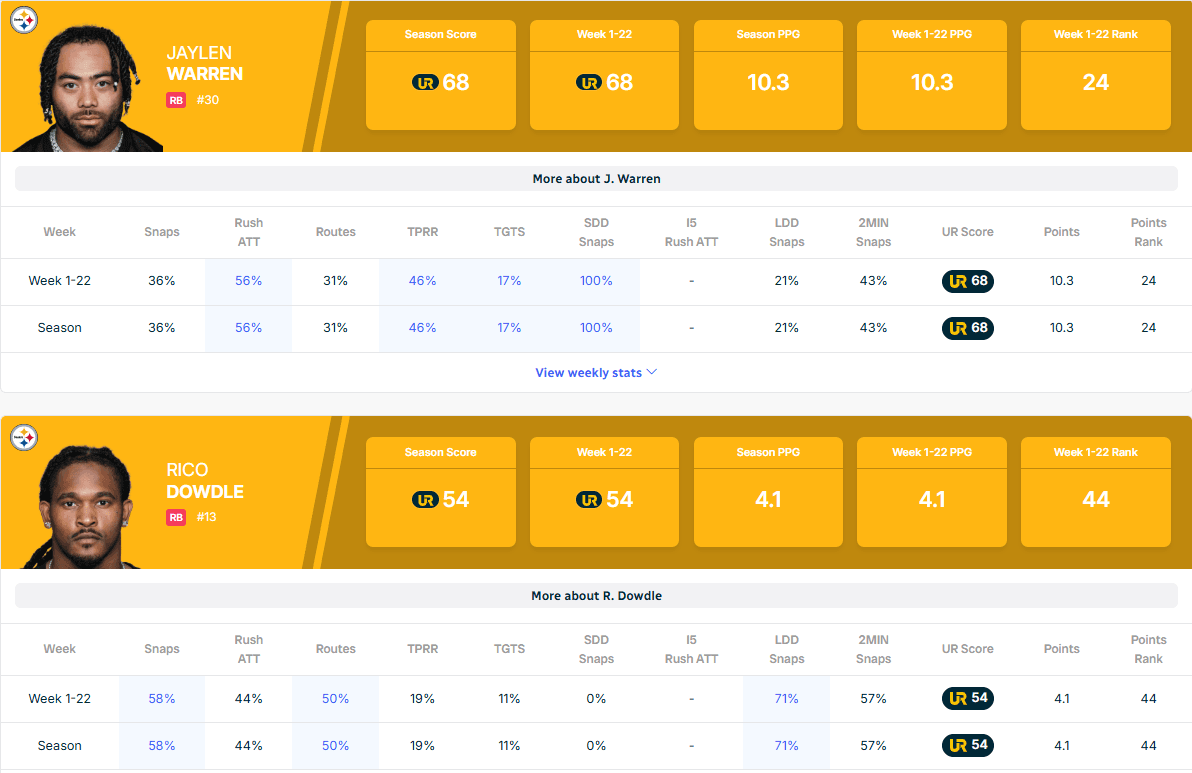
Mike McCarthy indicated this would be a rotation with two backs they think can perform all jobs. Eventually, a hot hand could take the reins here, but for now, it is a tough backfield to expect much value from in the short term.
Warren and Dowdle are both borderline RB3 options thanks to a near-even backfield split.
Washington Commanders
Jacory Croskey-Merritt emerged as the lead of a committee with a 50% snap share, handling 55% of the rushing attempts. However, rumors of an expanded passing-game role from camp did not materialize, with a 34% route participation rate and 3% target share. Bill handled 1 of 2 attempts inside the five-yard line. He scored 12.6 points with a 56 Utilization Score.
Raschaad White played 41% of snaps, including all of the LDD work, but handled only 24% of the attempts with a 7% target share.
To further complicate things, Kaytron Allen handled 14% of the attempts, including 1 of 2 attempts inside the five-yard line.
Croskey-Merritt is HOLDING STEADY as a mid-range to low-end RB3 while White is HOLDING STEADY as a low-end RB4.
Kaytron Allen is a WAIVER WIRE RB6/7 stash option in an unsolidified backfield in deep leagues.
Minnesota Vikings
Camp reports painted Jordan Mason as the clear-cut early-down option who was expected to handle the majority of the rushing attempts, but that wasn't the case in Week 1. Mason held a 54% to 43% edge over Aaron Jones, but was not the runaway leader.
Mason finished the day with a 48% snap share and was rarely used in the passing game with a 23% route share. He scored 11.9 points with a 49 Utilization Score.
Jones was also rarely used in the passing game, with a 23% route share, with Vikings QBs under pressure on 40% of dropbacks. That led to a lowly target share of 5%. Joneshad a 46 Utilization Score with 10 points.
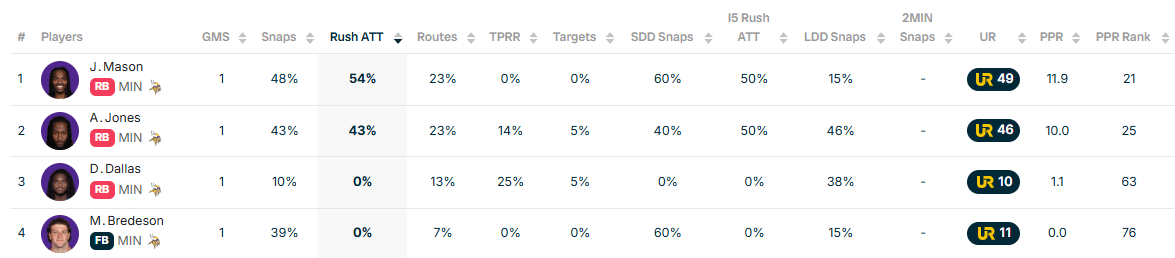
Further complicating matters, DJ Dallas played 10% of snaps, chipping in on some passing-down situations
On paper, the Vikings have a solid offensive line, and the team showed signs of life, scoring four TDs against Green Bay. But both backs averaged less than 0.5 yards before contact in Week 1.
Mason and Jones are RB3 options moving forward until someone gets the hot hand. Demond Claiborne is a name to remember in deep leagues if Mason and Jones continue to struggle.
Get 20% off a Tier 2 FantasyLife+ subscription by using code: UR20 to read the rest of the Utilization Report!
 3. Christian Watson and Matthew Golden's Stock Is On The Rise.
Watson scored 32.7 in a Week 1 eruption game. For those that know Watson as a deep maven, that was not his role in Week 1, which matches his preseason Utilization and camp reports.
First, his average route depth was 8.4 yards—well below his marks of 11.4 and 10.8 in the two previous seasons. Second, Watson is moving around the formation. He played from the slot on 25% of snaps and is the Z receiver, not the X. Third, he is getting more motion plays. He had 15% in the first game.
The result is more opportunities for targets and for the speed demon to unlock his YAC prowess. Watson collected a 21% target share on an 83% route participation rate.
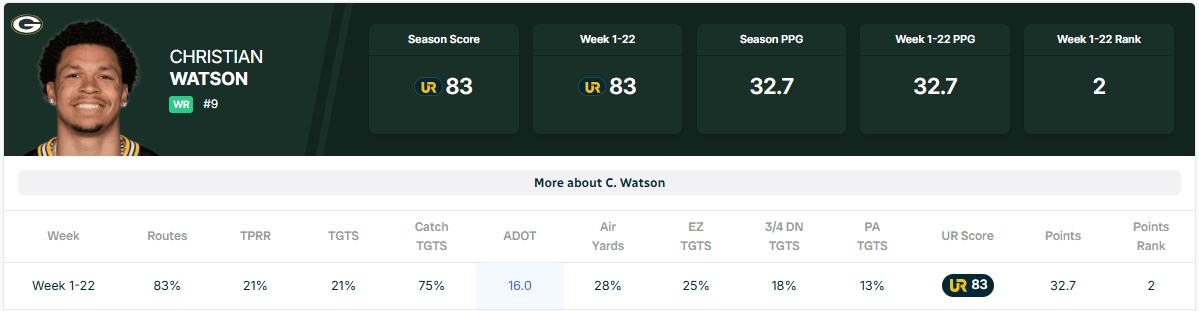
Historically, WRs with a similar Utilization Score have averaged 16.8 PPG with the 77% finishing as a WR1. However, the Utilization Score gives ~20% weight to fantasy points as a proxy for talent and offensive situation. After all, we want players that can do something with their opportunities.
The challenge with that on a one-week sample is that it can boost a player like Watson two high after notching 32.7 points. So, while I love Watson (he was one of my most drafted WRs), my view is a little more reserved and we can leave room for him to continue to move up.
Watson UPGRADES to mid-range WR2 status but could be knocking on WR1 territory soon.
Matthew Golden didn't have the same box score boom as Watson, but still scored a very strong 15.5 points. And he beat Watson in Utilization Score with an 88. Golden led the team with an 87% route participation rate and a whopping 31% target share.
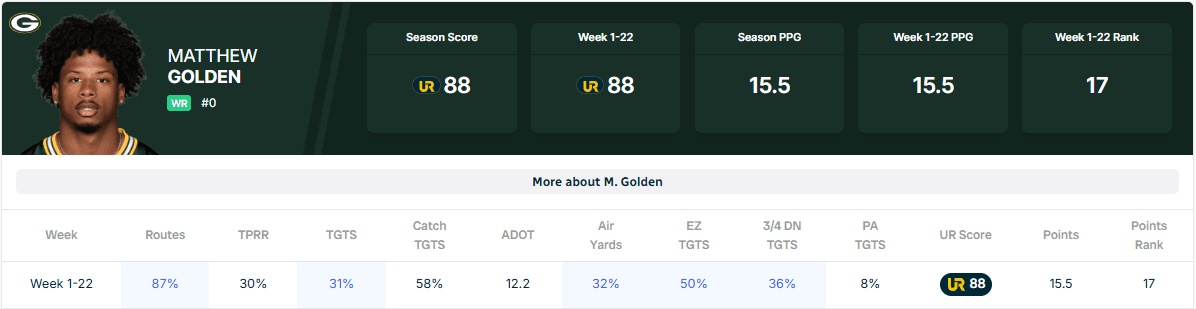
The 2025 Round 1 NFL Draft pick operated as the X WR playing on the boundary 100% of plays, but wasn't just a deep threat. He registered a 12.2-yard aDOT and a 9.2-yard average route depth. His Week 1 performance is impressive, considering how much harder it is to be successful in that role.
The Rookie Super Model viewed Golden as a reach in last year's draft, but he still had some strong comps—one was Ladd McConkey.
Again, this is a small sample, but historically, WRs with a Utilization Score in his range have averaged 18.2 PPG, with 96% reaching WR1 status. Similar to Watson, I am not going that far after one game, but Golden's stock is skyrocketing.
Golden UPGRADES from WR4 status to high-end WR3 territory and has a shot at a WR1 season.
 4. Parker Washington Boomed In Week 1, But Does He Need More Routes?
Washington was the catalyst for the Jaguars offense down the stretch into the NFL playoffs last season. He averaged 18.3 PPG in eight healthy contests with a 27% target share.
That success bled over into Week 1 with Washington scoring 19.3 points and leading the team with a massive 29% target share.
Washington aligned from the slot on 38% of snaps, attacking all layers of the field with an 11.5 average route depth. He led the team with 102 air yards (42%), and 33% of his targets came off of play action—a fantasy points booster for WRs.
But Washington's Utilization Score came in a tad lower than expected because of a 72% route participation rate.
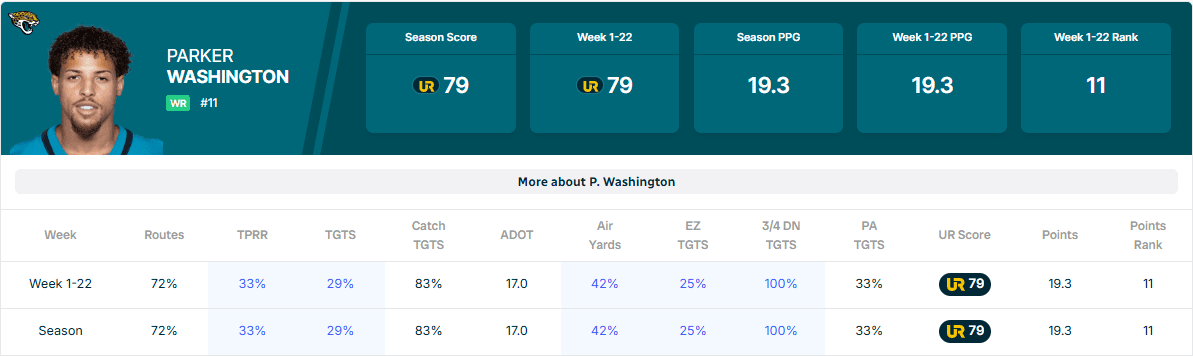
Historically, that is in WR3 to WR4 territory. Since 2012, only one WR has posted a 25%-plus target share with a route share between 70 and 80%. But it is a name Liam Coen is familiar with from his time with the Rams: Puka Nacua (2025).
Trying to thread the Nacua needle isn't easy. Preferably, Washington sees more playing time moving forward. His historical Utilization Score comps averaged 14 PPG, with 7% reaching top-six status. The majority (50%) finished as WR2s.
Washington UPGRADES from high-end WR3 status to low-end WR2 territory. With more playing time, he could crush fantasy leagues. Hell, maybe he can do it without that!
 5. Is Dalton Kincaid Headed For Career Highs?
Kincaid secured a 69% route participation rate in Week 1, well above his mark of 51% last season. He scored 18 points finishing second on the team with a 23% target share. Kincaid attacked downfield with a 15.8-yard aDOT, accounting for 29% of the air yards. He posted a high-end Utilization Score with an 87.
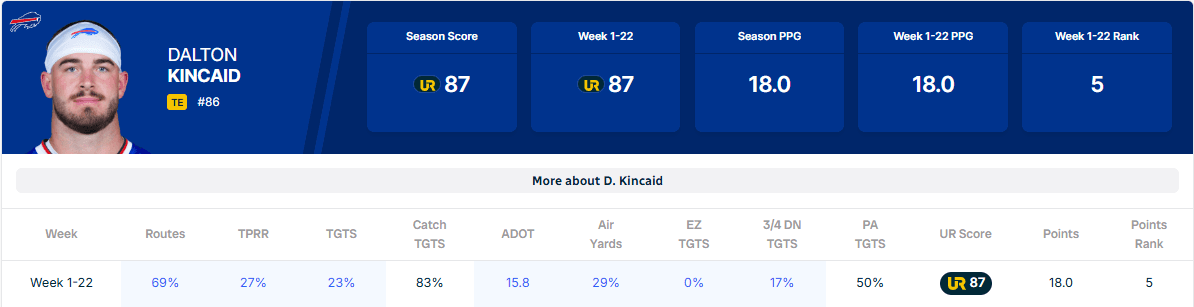
Historically, Kincaid had low route shares with FB Reggie Gilliam, who moved on to the Patriots.
That means when the Bills want to go heavy now, it is with multiple TEs instead of two RBs. Buffalo utilized 13 personnel on 40% of snaps and 12 personnel on 8% of snaps in Week 1. Kincaid played 95% of those snaps with an 83% route participation rate.
- 11 Personnel: 68% route participation
- 12 Personnel: 33% route participation
While we prefer TEs that reach an 80% route share or higher, 70% is well within range and Kincaid could expand beyond that if he continues to produce like Week 1. Behind DJ Moore, the team is starving for receiving options.
Historically, TEs with an 87 Utilization Score have averaged 14.3 PPG with 93% finishing inside the top-six options. I am not pushing Kincaid that high yet on a one-week sample, but the former Round 1 NFL Draft pick has that in his range of outcomes.
Kincaid UPGRADES to the TE7-9 range after a strong Week 1 performance.
 6. Isaiah Likely Climbs The TE Rankings After Week 1.
Similar to Kincaid, Likely notched a better route participation rate than we have historically seen from him at 68%. Playing time was a question mark entering the season despite his free agency contract.
The team added Patrick Ricard in the offseason as well. With the Ravens, Likely played only 40% of snaps in 21 and 22 personnel (packages with a FB on the field). And camp reports suggested Theo Johnson might handle more work.
The Giants utilized 21 and 22 personnel on 41% of the plays in Week 1—11% and 21% above the NFL average, respectively. Likely had a 50% route share across those two personnel groupings. In 11 personnel, he played 75% of the pass plays, which was a grouping blocked by Mark Andrews with the Ravens.
In Week 1 against the Cowboys, Likely led the team with a sizzling 29% target share, scoring 25.8 points and registering a 96 Utilization Score. He scored more points than any other TE to kick off the season.
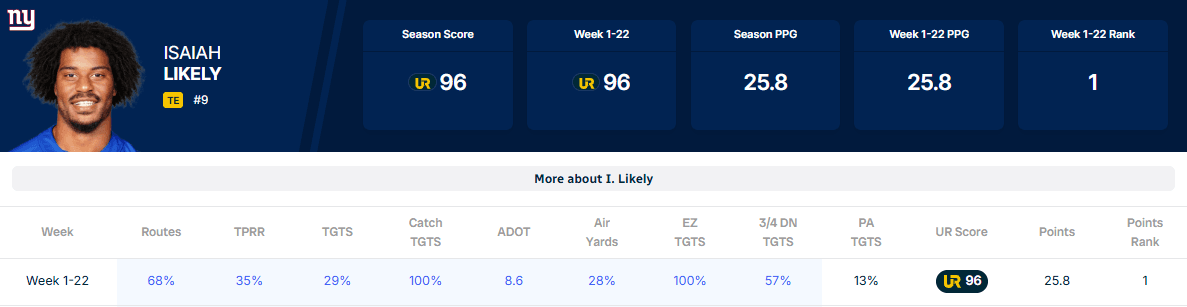
While we prefer TEs with an 80% route share or higher, the Giants have a gaping hole in their target pecking order behind Malik Nabers, and Likely is the favorite to fill that spot.
Likely UPGRADES to low-end TE1 status and offers more upside if his role continues to grow.
7. Utilization Score Underperformers
The Utilization Score is made up of the fantasy data points that have historically correlated the most strongly with future fantasy success. It is a similar but different concept compared to expected fantasy points. How it differs:
- Accounts for snaps and routes in addition to attempts and targets.
- Accounts for catchable targets and catchable air yards.
- The underlying role accounts for ~75% of a player's Utilization Score.
- Uses fantasy points per game (PPG) as a proxy for talent (i.e., has the player done something with their opportunities). Fantasy PPG is worth ~25% of a player's Utilization Score.
 Colston Loveland | TE | Bears
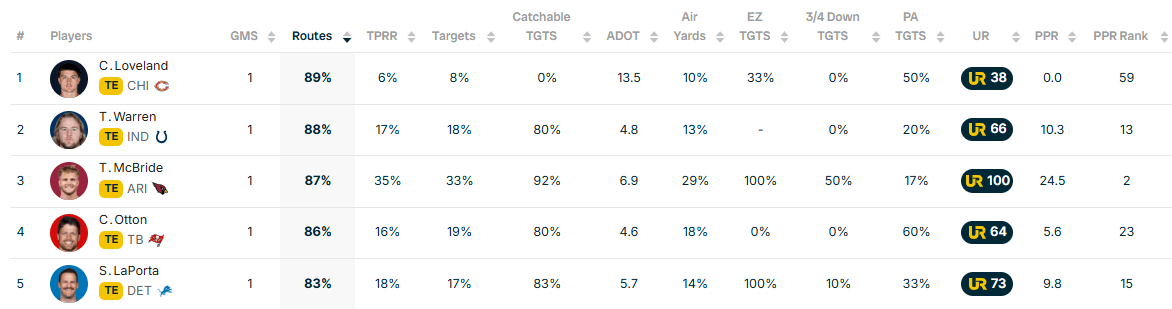
Loveland didn't technically post a high Utilization Score. It was low (38) because of an 8% target share. But this section highlights buy-low candidates, and Loveland is exactly that after posting an ELITE 89% route participation rate—the highest mark of any TE in Week 1.
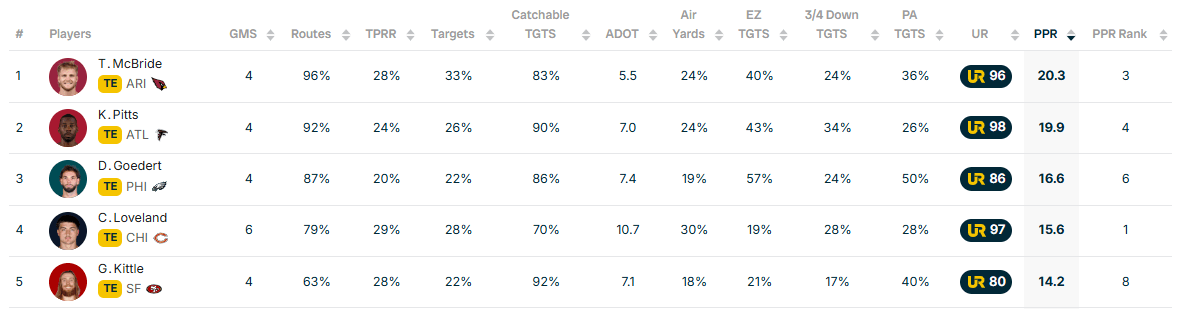
Loveland erupted late last season, with 15.6 points per game over a six-game stretch, including the NFL Playoffs as the starter.
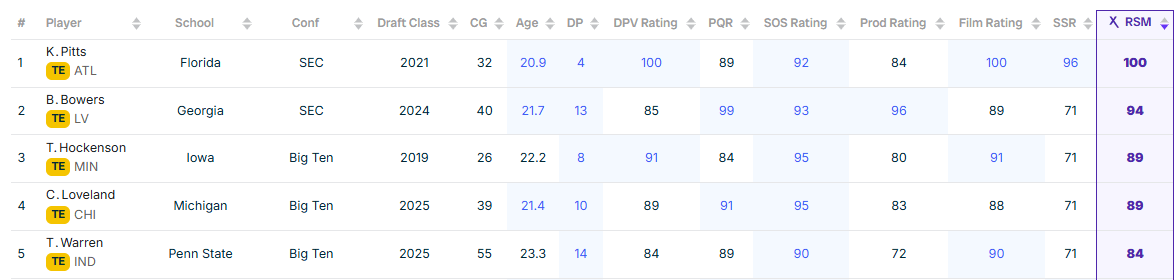
And he is the No. 4 TE prospect all-time in the Rookie Super Model.
All of this makes him a player we want to take a long view on. Especially given how great the Bears offense looked in Week 1, scoring eight TDs. While that obviously will come down, Ben Johnson is an elite coordinator, and we could easily have a top-three offense on our hands.
Loveland is HOLDING STEADY as a high-end TE1 and now is a great time to inquire about securing his services from your leagumates.
 Rhamondre Stevnson | RB | Patriots
Stevenson finished as the RB16 in Week 1 with 14.5 points. TreVeyon Henderson didn't play, but Stevenson's Week 1 Utilization was impeccable: 85% snaps, 72% attempts, 69% routes, 19% targets. He tallied a 92 Utilization Score—the sixth-best mark in Week 1.
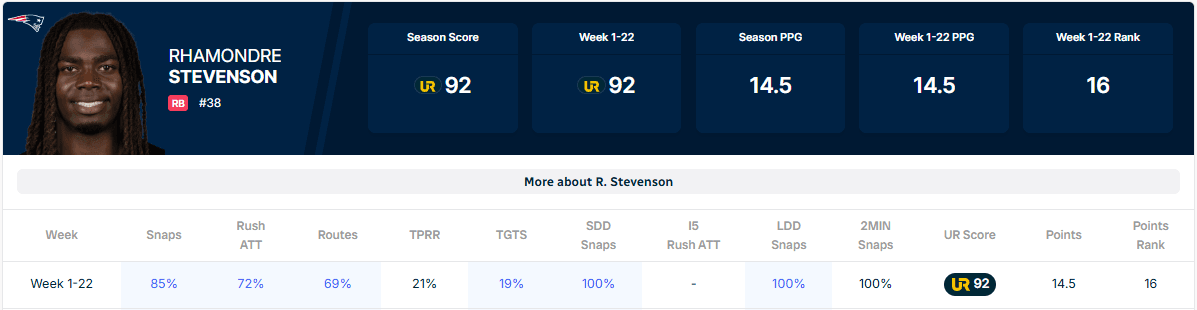
That is a fantastic workload on a team that ranked 8th in plays with 67 against the Seahawks. Looking at the Weekly Utilization Score leaderboard, you can see the clear outlier, whose points are too low:
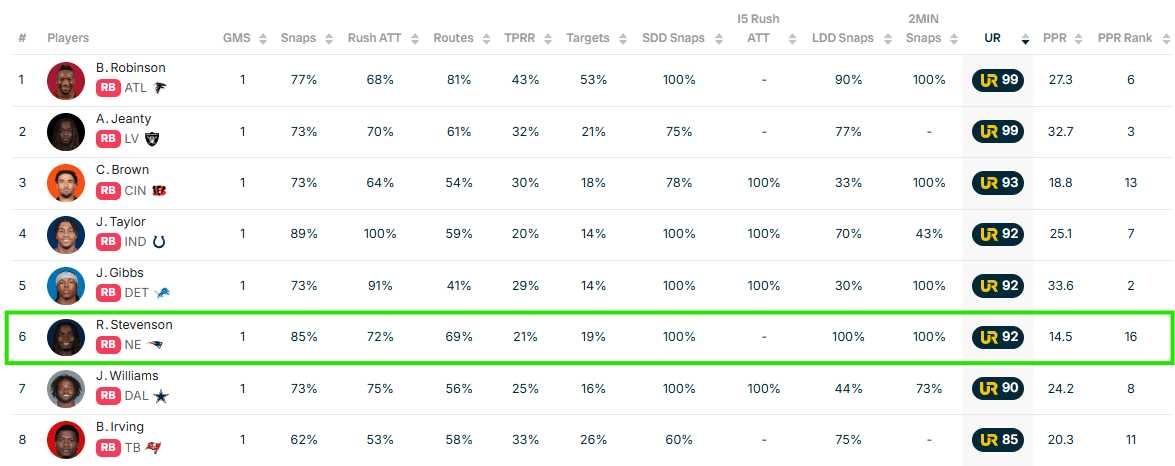
We should expect these numbers to drop when Henderson returns, but Stevenson built a large cushion, according to beat reports this preseason.
Stevenson is a mid-range RB2 with RB1 upside until Henderson pushes for more work.
8. Utilization Score Overperformers
D'Andre Swift | RB | Bears
Swift delivered 32.4 fantasy points in Week 1, finishing as a top six RB. However, his 68 Utilization Score of 68 was by far the lowest of the top 10 RBs.
Against the Panthers, he handled 57% of the snaps and accounted for 56% of the rushing attempts. He was in a route on only 24% of pass plays and had a 4% target share. And this wasn't due to blowout conditions. Swift was at a 54% snap share at halftime.
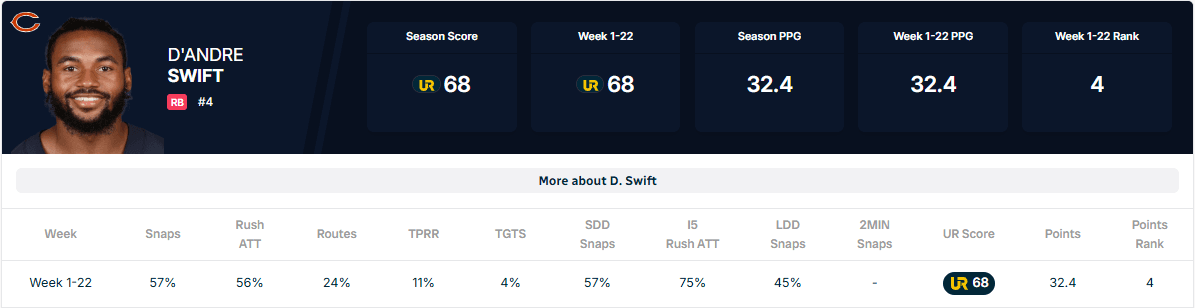
This isn't to say that Swift is a bad fantasy option. It just means he outperformed his workload by a margin that is rarely sustained.
He was in the same role as last year when he averaged 14.1 PPG. In 2025, he had a 58% snap share with 54% of the attempts and a 49% route share. He had a 70 Utilization Score.
We love the Bears offense and want shares, but Swift's historical Utilization Score comps averaged 13.8 PPG with 21% finishing in the top-12.
Swift is HOLDING STEADY as a strong RB2 play but is moveable if one of your leaguemates views him as an RB1.
9. Week 2 Waiver Wire Roundup
For a full breakdown of waiver wire pickups and FAAB advice for Week 2, Alex Cupps brought us an in-depth write-up. See below for my quick hitters on who to target on the Week 2 waiver wire.
Running Back
- Kaelon Black | 49ers (27% rostered in Yahoo leagues): Black handled 50% of the rushing attempts and garnered a 44% snap share in Week 1. Christian McCaffrey was coming off a preseason injury, making it hard to say if Black will hold onto this workload. But regardless, it was a massive vote of confidence from Kyle Shanahan, propelling Black into must-roster handcuff status at a minimum. He could be similar to Blake Corum. Black is a PRIORITY WAIVER WIRE TARGET if you need RB depth.
Handcuff Options Rostered Under 20%: Emmett Johnson (KC), Braelon Allen (NYG), Seth McGowan (IND), George Holani (SEA), Emari Demercado (DAL)
Wide Receiver
- Jalen Coker | Panthers (61% rostered in Yahoo leagues): Coker is only available in smaller leagues, but I wanted to add him here in case you play in one of those. He is by far the top WR waiver wire target heading into Week 2. The Year 3 WR led the team with a 28% target share on a 93% route share, notching a 93 Utilization Score with 33.8 points. The undrafted free agent WR might be following in the footsteps of another former undrafted WR: Adam Thielen. Coker operated from the slot on 39% of snaps, and 33% of his targets came on play action. Bryce Young has historically been a terrible QB for fantasy weapons, which is the limiting factor. But it is hard to ignore an eruption game from a young ascending player early in the fantasy season. Coker UPGRADES to borderline WR4 status and is THE WAIVER WIRE PRIORITY TARGET for small leagues.
- Caleb Douglas | Dolphins (12% rostered in Yahoo leagues): The Round 3 rookie pick finished second on the team in route participation (86%) and target share (24%), scoring 14.4 points. The raw volume was problematic, which ultimately kept his Utilization Score down (69). But he did have a strong downfield connection with Willis. His 16.7 aDOT led to 100 air yards, and 5 of his 6 targets were catchable. He ranked first on the team in average route depth at 11.8. Douglas UPGRADES from WR6 territory to WR4 status and is a WAIVER WIRE TARGET in medium to deep leagues.
- Tre Harris | Chargers (4% rostered in Yahoo leagues): With Ladd McConkey exiting the game on the sixth drive, Harris stepped into the WR2 role. The 2025 Round 2 NFL Draft pick only scored 5 points, but finished with a 77% route share and a 23% target share. Prior to McConkey's injury, Harris was on the field for 53% of pass plays as the WR3 for the team. If McConkey misses time, Harris should play a significant role. If he performs well, he could push Johnston for playing time when McConkey returns. Harris UPGRADES from WR6 status to WR4 over the short term if McConkey is out and offers WR2 upside.
- Denzel Boston | Browns (28% rostered in Yahoo leagues): Boston led the Browns receiving corps in Week 1 with 13.9 points. The camp reports of a full-time role were true—he registered a 97% route share as the boundary X, playing outside on 95% of snaps. His average route depth of 13.2 ranked first on the team. He led the team with 116 air yards (100%) and secured a 46-yard TD, demonstrating high-end tracking ability. While the Week 1 playing time and results are encouraging, Boston's 13% TPRR demonstrates the challenges of playing this sort of role—he led the team with a 13.6 average route depth. Boston is HOLDING STEADY as a WR5 option. He is a WAIVER WIRE target, but not one to bid aggressively on.
- Dontayvion Wicks | Eagles (16% rostered in Yahoo leagues): I am skeptical that Wicks holds onto a high-end role over the course of the season, but he has flashed upside in the past. In Week 1, he was the WR2 with a 91% route share and 18% target share, including a 64-yard bomb and an EZ target he converted into a TD. My gut says Wicks takes a backseat to Makai Lemon before the season is done, but he provides short-term appeal, and I could be wrong! Wicks UPGRADES to WR5 territory.
- Devaughn Vele | Saints (8% rostered in Yahoo leagues): Vele tallied a 92% route share and an 18% target share. He ended the day with 19.9 fantasy points and an 82 Utilization Score. However, huge play volume helped. The Saints ran 86 plays including overtime—by far the highest mark of Week 1. Vele is due for regression, but UPGRADES to WR5 territory while Jordyn Tyson is recovering from his hamstring injury.
- Elijah Sarratt | Ravens (0% rostered in Yahoo leagues): Sarratt didn't play in Week 1, but was the No. 9 WR in the 2026 draft class in the Rookie Super Model. His 94 Production Rating ranks No. 7 since the model's inception in 2018. With Ja'Kobi Lane expected to miss time with a wrist fracture and Zay Flowers' status in question for Week 2, Sarratt will play a larger role. Rashod Bateman stunk up the joint in Week 1, with a lowly 4% target share on a 90% route participation. Sarratt UPGRADES to WR6 territory and is a WAIVER WIRE stash option in deep leagues.
- Antonio Williams | Commanders (2% rostered in Yahoo leagues): Williams only notched a 29% route participation rate, but earned a 36% targets per route run (TPRR). With Chig Okonkwo battling a hamstring injury, we could see more 11 personnel, and the depth chart in front of Williams is not insurmountable. Williams is a min-bid stash option in leagues with deep benches.
Tight End
- Kenyon Sadiq | Jets (14% rostered in Yahoo leagues): The Round 1 pick was the TE2 behind Mason Taylor in Week 1, but was the most productive. He scored on a rushing TD and notched an electric 25% TPRR. His route share of 46% is too low to be in starting lineups, but with Omar Cooper Jr. suffering a low-ankle sprain, the Jets could opt for more multi-TE sets as a way to get their best players on the field moving forward. The Jets only dropped back to pass on 41% of plays thanks to leading by 4+ points on 83% of plays—that won't hold against tougher opponents, opening up more passing volume. Sadiq is HOLDING STEADY as a low-end TE2, but is an UPSIDE STASH. He should be rostered if your TE1 is more of a floor option in deep formats.
- Pat Freiermuth | Steelers (6% rostered in Yahoo leagues): Freiermuth garnered a strong 76% route share in Week 1 after splitting playing time evenly with Darnell Washington in the preseason. He still wasn't a primary target (16%), but saw an endzone target and scored 15.6 points. His 76 Utilization Score aligns with low-end TE1s if it sticks. Freiermuth UPGRADES to mid-range TE2 territory and could become a borderline TE1. But don't get too aggressive with your bids; this offense is still crowded.
11. It's a Fugazi!!!
A few players pop up weekly in the fantasy box score but lack the underlying goods to back them up. They are best left for the next fantasy manager to worry about.
Donnie Brasco: "You should give it to somebody who doesn't know any better because that's a fugazi."
- Kalif Raymond | Bears: Raymond led the Bears with a 45% target share in Week 1. But he only ran a route on 58% of dropbacks and has never been a high-end target earner. Raymond could be a pain in the ass for Luther Burden III managers, but would need to ascend to the WR2 role to have value. And much of his playing time in Week 1 was opened up by Rome Odunze's route limitations (58%) battling through a calf injury. I'm out, dog.
Utilization Bytes For Week 2 Fantasy Football
Quarterback
- Kyler Murray | Vikings: Murray exited in the first quarter with a concussion, putting his status in doubt for Week 2. Nothing new to report here, but I am not cutting Murray. He remains a dual-threat in a great scheme with superb weapons. Murray is HOLDING STEADY as a borderline QB1 with mid-range QB1 upside.
- Malik Willis | Dolphins: Willis collected 17.7 fantasy points against the Raiders as the QB11. He scrambled on 24% (9) of his dropbacks and accounted for 8% (1) of the designed rushing attempts. He is a near lock to finish as one of the top rushing QBs in 2026, but his 14% sack rate cost us five dropbacks—which is concerning for a team that ran the fourth-fewest regulation plays at 50. They also snapped the ball with only 4.86 seconds remaining on the play clock in neutral plays—the slowest offense in the NFL in Week 1. Willis is HOLDING STEADY as a mid-range QB2, but needs a volume boost to become a player we can trust regularly in the top 12.
Running Back
- Bijan Robinson | Falcons: Despite a dysfunctional Falcons offense, Robinson did what superstars do, scoring 31.3 points. He notched a 99 Utilization Score with a 53% target share, with Cooper Rush dinking and dunking his way down the field. The Falcons completely shelled up with a -14% dropback rate over expected (DBOE), but Robinson still prevailed. Robinson is HOLDING STEADY as the RB2.
- Christian McCaffrey | 49ers: McCaffrey scored 13.8 fantasy points and saw his lowest snap share while healthy since joining San Francisco at 55%. He was coming off a preseason injury, so we could see this rebound. However, the team hinted at lightening his load this offseason and drafted Black in Round 3. So, we could see a smaller workload for McCaffrey between the 20s. His 24% target share will help insulate any downturn, but those touches aren't worthless if we are aiming for 20+ PPG. McCaffey DOWNGRADES to mid-range RB1 status, but we will keep an eye on it, y'all.
- Derrick Henry | Ravens: Henry continues his annual tradition of defying his Utilization Score (69), which takes a hit due to a lack of passing-game involvement (30% route participation). But Baltimore is an elite offense, and Henry is an outlier where we just tell the URScore to take a hike—King Henry rocked box scores with 35.3 points (RB1). His only issue is trailing game scripts, which is where we see his points drop, which is what the UR Score is telling us. Henry is HOLDING STEADY as a low-end RB1 with RB1 overall upside in any given week.
- De'Von Achane | Dolphins: Achane let fantasy managers down with only 10.6 points in Week 1. His role was fantastic, notching an 88% snap share, 85% attempt share, and a 78% route participation rate. But low team play volume (see Willis above) torpedoed those shares, resulting in 11 attempts and 4 targets. Willis's scrambling might have slightly impacted Achane's target share, but it was still very good at 16%. The next-biggest issue: this offense might not score many points. These were the reasons Achane was not a Round 1 pick for me in 2026, but his bellcow workload should help dampen the blow in the long view. If his 79 Utilization Score holds, his historical comps averaged 15.4 PPG, with 41% finishing as top-12 options. Achane is HOLDING STEADY as a low-end RB1.
- Jahmyr Gibbs | Lions: If you had the No. 1 pick in your fantasy draft, congratulations—you might make your fantasy playoffs on Gibbs alone. With Montgomery gone, Gibbs bogarted 91% of the rushing attempts and collected a 14% target share, resulting in a 93 Utilization Score and 33.6 fantasy points. He averaged 5.4 yards per attempt with 16.7% of his attempts going for 10-plus yards. Oh yeah, he posted 1.76 yards per route run (YPRR), which is more like a WR3 than an RB!!! Gibbs is the RB1, y'all. A GENERATIONAL 1.01 that could feed families for decades.
- James Cook | Bills: Cook registered a disappointing 9.9 points in Week 1 against a tough Texans defense, with the Bills throwing more than normal with a 3% DBOE. Still, Cook's underlying Utilization was strong with a 69% snap share and 68% rush share. He also notched a 56% route participation rate—12 percentage points higher than his 44% for 2025. His 25% TPRR was elite. The door remains open for more pass-down work under Pete Carmichael, but we will have to see how Ty Johnson impacts things when he returns. Cook is HOLDING STEADY as a mid-range RB1.
- Javonte Williams | Cowboys: Williams dominated the Cowboys backfield with a 73% snap share and controlled 75% of the rushing attempts on his way to 24.2 points with a 91 Utilization Score. With the depth chart obliterated, he also registered a 61% route share. While he isn't likely to repeat his 16% target share often given the Cowboys' other weapons, that route share puts him in play for 3-5 targets per game. He performed well with Dallas only running 52 plays, a number that will be much higher in future games. Williams UPGRADES to borderline RB1 territory.
- Kyren Williams | Rams: Williams remains in a split backfield with Blake Corum. The veteran RB delivered 15.5 points, handling a 41% rush share. But that number was higher earlier in the game, before the Rams pulled their starters. With Matthew Stafford still in the game, Williams handled 52% of the attempts versus 43% for Corum. Williams also led the team with an 80% route participation rate with Stafford in—although the Rams rarely target their backs. Williams is HOLDING STEADY as a mid-range RB2, and Corum is a borderline RB3 with contingent RB1 upside if Williams misses time.
- Omarion Hampton | Chargers: Hampton scored only 8.3 points in a smash spot against the Cardinals, catching fantasy managers off guard. However, I remain bullish on him after he handled 75% of the rushing attempts. He'll lose some passing-down reps to Keaton Mitchell, which hurts his floor in games where the Chargers fall behind, like Week 1. But if you are still a believer in the Chargers over the long term (I am), Hampton profiles similarly to Derrick Henry. Hampton is HOLDING STEADY as a low-end RB1.
- Quinshon Judkins | Browns: The story remains the same as last year for Judkins. He'll dominate touches, but the offensive environment is a challenge. The Year 2 RB handled 67% of the snaps and bogarted 67% of the rushing attempts, but came up short with only 7 fantasy points thanks to a trailing game script that transformed his 67% rush share into only 12 attempts. The Browns ran the second-fewest regulation plays (49) in Week 1 and scored only 10 points. To their credit, they tried to stick with the run with a -6% DBOE. On a positive note, Judkins posted a 48% route participation rate—up from 30% last season. With Dylan Sampson's future in question due to a knee injury, Judkins could remain on the field more often on passing downs. But the Browns have more weapons, which hampers his target-earning potential. Judkins is HOLDING STEADY as a low-end RB2.
- Saquon Barkley | Eagles: Fantasy drafters are probably thinking, "here we go again," but Barkley looked good, averaging 5.5 yards per carry with all of it coming after contact. Barkley was met by Sonny Styles in the backfield on multiple occasions. Still, the Eagles offensive line had the fourth-highest run-block grade per PFF (75). Barkley dominated the backfield with an 82% rush share and 71% snap share. Unfortunately, his route participation rate was 35%—well below his 61% last season. If that holds, he could become more game-script dependent, like players such as Hampton. Barkley DOWNGRADES to low-end RB1 territory.
- Tony Pollard | Titans: Pollard split snaps evenly with Tyjae Spears but led the team with 70% of the designed rushing attempts. Spears handled 44% of the routes versus 21% for Pollard—both backs had to remain in to block behind a struggling offensive line. Pollard could have better days in cooperative game scripts, but when will those come? Yeah, maybe never. The Titans got smashed by the Jets—theoretically a manageable matchup. Pollard is HOLDING STEADY as a borderline RB3 we really don't want near our fantasy lineups at the moment.
Wide Receiver
- Alec Pierce | Colts: Pierce was limited to a 65% route participation rate coming off of injury, but he notched the No. 1 TPRR on the team at 27%. Despite missing all of training camp, the newly minted WR led the team with 10.1 points. While his 13.6 average route depth was the deepest of the Colts, he wasn't a go-route merchant yesterday. Pierce ran in-breaking routes on 59% of routes—where the likelihood of a target improves. We heard Indianapolis wanted to do this season, and it played out in Week 1. The offense has a lot of mouths to feed, but if this role sticks, Pierce's value could rise as he gets healthy. Pierce UPGRADES to low-end WR3 status long-term. For now, he is a WR4 until we see a full-time role.
- Carnell Tate | Titans: The No. 4 pick from the NFL Draft was the No. 1 WR for the Titans with a 92% route participation rate and a 22% target share. But that translated to only 7.8 fantasy points in an offense that tied for the second-fewest regulation plays (49) and second-lowest points (10). Cam Ward had very little time to operate under intense pressure. On a positive note, Tate played from the slot on 30% of snaps, and his average route depth was 9.1 yards. There were concerns of a heavy go-route diet, but that didn't come to fruition (11%). Tate DOWNGRADES to WR4 territory but remains the best bet on the Titans to make a difference in fantasy in 2026.
- Chris Bell | Dolphins: The rookie WR played 54% of pass plays in the first game. That is a positive step as he recovers from a late-season ACL injury in 2025. He didn't get much going, with a 10% TPRR. For now, Bell is the WR3 for Miami. Bell is HOLDING STEADY as a WR6 option in deep formats, but can be dropped in shallow leagues.
- Chris Godwin | Buccaneers: Godwin played a full-time role with an 89% route participation rate, but finished fourth on the team with a 15% target share. I am not overly concerned since Cade Otton and Irving were two of those players, which was helped by a checkdown game script with the Buccaneers in trail mode and the Bengals opting to guard the intermediate and deep zones. Godwin operated from the slot on 57% of reps but was not in motion often (7%). Godwin is HOLDING STEADY as a mid-range WR3 despite his 8.3 points in Week 1.
- Chris Olave | Saints: Olave averaged 18.8 PPG with Tyler Shough last season, and the duo picked up where they left off with the veteran WR lighting up the fantasy scoreboard with 28.2 points. Olave garnered an 89% route participation rate despite visiting the injury tent twice, finishing the day with 28.2 points and a 93 Utilization Score. Olave kicked into the slot on 36% of snaps and had an average route depth of 10.2. He is HOLDING STEADY as a low-end WR1 with high-end WR1 upside while Jordyn Tyson is out.
- Davante Adams | Rams: Adams bombed with 5.6 points, but his role was the same while the starters remained in the game. He had a team-leading 84% route participation rate and a 25% target share. He played only 19% of snaps in 13 personnel, a grouping that helped boost his numbers early last year, but the bigger takeaway is that he is still a staple of the Rams offense. Adams is HOLDING STEADY as a high-end WR3.
- Deebo Samuel | 49ers: Samuel notched a 57% route share after De'Zhaun Stribling exited the game. He led the team with a 37% TPRR and came through with 18 fantasy points. Samuel will need more playing time to keep up his Week 1 production, but with Stribling sidelined, the team could ramp up his role. Samuel UPGRADES to WR4 territory and offers WR2 upside if playing 75%+ snaps.
- DeVonta Smith | Eagles: Smith only managed 8.3 points in Week 1, leaving fantasy managers wondering if he can make the leap with A.J. Brown gone. I remain bullish on Smith; he was clearly the WR1 with a 97% route share and a 23% target share. We have a multi-year track record with Smith, and he has historically been a monster on routes without Brown. The Eagles were much more committed to the pass in Week 1 with a 7% DBOE in their first game under Sean Mannion. Better days are coming. Smith is HOLDING STEADY as a borderline WR1.
- DJ Moore | Bills: The recently acquired WR looked in sync with Josh Allen in Week 1, earning multiple downfield targets when Allen extended the play. That is the narrative we heard all summer from camp, and it played out. Moore had a 21.9 aDOT and led the team in air yards with 46%. He also led the team in target share (27%) with seven looks on the day, scoring 21 points. The 81% route participation rate wasn't great, but the Bills threw the ball more than in the past few seasons with a 3% DBOE. If Buffalo reverts to their run-oriented attack, Moore's production could come down with this route share, but he was the clear-cut No. 1 out of the gate. Moore UPGRADES to mid-range WR2 status.
- DK Metcalf | Steelers: Metcalf's 8-point performance was disappointing, but he bossed a 100% route share and led the team with a 26% target share. He finished the contest with 171 air yards on nine looks, with Aaron Rodgers showing a new willingness to push the ball downfield. Rodgers notched a 9.8 aDOT—well above his 6.4 last season. It's a small sample, but the offseason reports have pointed to Metcalf in a dominant role. While he played mostly from the boundary, his 8.1 average route depth points to a more versatile role—he ran in-breaking routes 54% of the time. Last year that number was 37%. He still has to deal with new target competition, but this was a positive Week 1. Metcalf UPGRADES to high-end WR3 territory.
- Drake London | Falcons: London slipped on a banana peel and hit his head on 5.5 fantasy points in Week 1 with Cooper Rush under center. Long term, I am not concerned about London—he has proven his worth. But if we see Rush start again, he gets a short-term DOWNGRADE to WR2 territory.
- Emeka Egbuka | Buccaneers: Egbuka scored 11.3 points coming back from a toe injury. The Year 2 played a full-time role with an 89% route participation and was second on the team with a 22% target share behind Irving. He was in motion on 36% of routes and operated from the slot 28% of the time—great marks. Egbuka is HOLDING STEADY as a low-end WR2, but will quickly improve his standing if/when we know he is playing at full strength.
- George Pickens | Cowboys: Pickens bombed in the box score with only 5.8 points in Week 1, but led the team with an 89% route participation rate. The Cowboys offense came out flat, but this is probably just a blip. Pickens didn't see the expanded slot role (5%) the coaching staff teased in previous weeks. But he dominated without that last year. Pickens is HOLDING STEADY as a low-end WR1.
- Ja'Marr Chase | Bengals: Weird stuff happens in small samples. Chase will be fine. He still notched an elite 97% route share. Chase is HOLDING STEADY as a high-end WR1.
- Jameson Williams | Lions: Williams didn't boom with 8.5 points but had an elite route participation rate of 95% and a WR2-worthy target share of 25%. Williams is HOLDING STEADY as a borderline WR2 with upside.
- Josh Downs | Colts: We FINALLY have a full-time role for Downs, who notched an elite 94% route participation rate against the Ravens. Unfortunately, he had a 9% TPRR, while Keenan Allen posted 23%. Those damn fantasy gods are cruel. On the one hand, Downs' playing time is HUGE. On the other hand, Allen's presence is hard to ignore. The veteran WR might not be what he used to be, but he has submarined Rome Odunze and Ladd McConkey's fantasy outlooks over the last two years. Downs UPGRADES to low-end WR3 territory—I wanted to go HIGHER but tried to stay sober-minded with Allen in the mix.
- Justin Jefferson | Vikings: After a down 2025 season, Jefferson returned to his ALPHA ways with a 100% route share and a 41% target share in Week 1. He finished with a 96 Utilization Score and 29.2 points. Kyler Murray could miss Week 2 due to a concussion, but Kevin O'Connell has found success with almost every QB not named J.J. McCarthy. Carson Wentz will take the wheel if Murray can't play. Jefferson is HOLDING STEADY as a mid-range WR1.
- KC Concepcion | Browns: As expected, Concepcion played the slot role (62%) in Week 1 and saw his route participation rate limited to 65%. He finished with 7.8 points. This should grow as the season progresses. While the offense is a massive concern, Concepcion is in the role we want. The Round 1 NFL pick was in motion on 21% of routes and had a sturdy average route depth of 10.7. Concepcion is HOLDING STEADY as a low-end WR3 long term and is a WR4 in the short term.
- Ladd McConkey | Chargers: Before stuffing a chest/rib injury on the sixth drive, McConkey was dominating. He had an elite route participation rate of 94% with a 38% target share, scoring 19.2 points. The Year 3 WR aligned from the slot on 59% of snaps, with 50% of his targets coming on play action. And he wasn't a traditional underneath slot option—his 10.3 average route depth was in the sweet spot for boom potential. McConkey UPGRADES to low-end WR1 territory upon his return from injury.
- Luther Burden | Bears: Burden dudded in Week 1 with 9.5 points after costing fantasy managers a Round 5-6 pick. He fumbled on the first drive, which might have opened the door for more playing time for Raymond. The biggest concern is whether Raymond forces a three-way rotation when Odunze plays a full-time role (58% route share in W1). But this is a long-term play in an offense we want to be part of. Burden DOWNGRADES to mid-range WR3 territory, but is a HOLD.
- Malachi Fields | Giants: Fields was the WR3 in route participation (62%) behind Darnell Mooney (76%) in Week 1. However, the rookie was the more-targeted WR with a 14% share versus 7% for Mooney. Fields remains a work in progress but is a name to monitor in the coming weeks as a waiver wire option. Fields is HOLDING STEADY as a WR6 stash in deep formats.
- Malik Nabers | Giants: The Year 3 WR posted a 71% route share in his first game back from ACL surgery. He was ELECTRIC when on the field, commanding a 38% TPRR. Nabers finished the night with 12.9 points and a 32% target share while leading the team in air yards (99). Get ready for launch, y'all. Nabers is a high-end WR2 in the short term and offers high-end WR1 upside as soon as his routes get back into the mid-80% range.
- Malik Washington | Dolphins: On the surface, it looks like Washington transformed into a downfield threat in Week 1 with a 19.0 aDOT. But under closer review, his average route depth was 6.8. While he led the team in routes (100%) and targets (32%), they were not high-leverage looks. You might get by with those numbers in a high-volume number, but that isn't the case in Miami in the league's slowest Week 1 offense. Washington is HOLDING STEADY as WR6 in deep PPR formats.
- Makai Lemon | Eagles: The Eagles leaned into 11 personnel the fifth-most in Week 1 (72%), and Lemon secured an 85% route share. While he busted in the box score with only 2.5 points, the playing time is encouraging for a Round 1 NFL Draft talent. The biggest concern with Lemon: the Eagles might view him as a gadget player—which isn't his strong suit. Lemon is best as a chain-moving intermediate target, but the coaching staff limited his route depth to 6.5 yards, with 50% of his targets coming on screens. The screens themselves aren't bad—they are great icing on the cake—but they can't be the entire course. Lemon was in motion on a mouth-watering 34% of routes, which matches the preseason buzz. Lemon is HOLDING STEADY as a mid-range WR4 with WR2 upside as the season progresses—I am not dropping him unless you're in very small leagues.
- Marvin Harrison Jr. | Cardinals: Harrison saw plenty of playing time with an 87% route share, but he struggled to generate targets (8%). Despite camp reports that Harrison would move around more, that wasn't the case, with 0% of his routes coming from the slot. He is the boundary option attacking downfield with the deepest average route depth of 12. This is a tough spot for Harrison. He hasn't shown much to this point in his career, and he plays the least friendly role in an offense where Trey McBride hogs many looks. Harrison DOWNGRADES to borderline WR4 territory with a Week 1 Utilization Score of 38.
- Michael Wilson | Cardinals: Wilson led the Cardinals WR room in route participation at 92% and finished third in targets at 19%. Wilson scored 10.6 points with a 62 Utilization Score. Kendrick Bourne finished second at 22% but was the WR3 with a 77% route share. Wilson aligned in the slot on 21% of snaps, but was in motion only 10% of the time, with Bourne getting more of that treatment (32%). It is only one data point, but through the preseason, Wilson was the move player, which helps boost fantasy points. If he doesn't have that role, it is a double whammy. It will hurt his ability to earn layup targets, AND it will improve the odds for Bourne. Wilson is HOLDING STEADY as a mid-range WR4.
- Puka Nacua | Rams: Nacua scored only 12.4 points but was in his usual role with an 80% route participation and a 38% target share when the starters were in the game. He was in motion 38% of the time. He caught only 5 of 9 targets, which kept his box score in check. Nacua is HOLDING STEADY as a high-end WR1.
- Quentin Johnston | Chargers: Johnston came up empty in the box score with 3.7 points in Week 1. But he was the WR2 with a 77% route participation rate and finished third in targets (19%). If McConkey misses time, Johnston could receive extra looks—his average route depth of 7.9 was down from last year, and he was in motion on 13% of plays. Johnston is HOLDING STEADY as a borderline WR3.
- Rome Odunze | Bears: Odunze was limited with a calf injury last week in practice and only had a 58% route share. So, it is hard to judge his 14% TPRR. But he was primarily working downfield with Burden and Raymond soaking up easy targets. Odunze DOWNGRADES to boom-bust WR4 territory until he is healthy and we can re-evaluate.
- Ted Hurst | Buccaneers: Hurst played the WR3 role with Jalen McMillan out, but McMillan could be back for Week 2. Hurst had an 83% route share with an 11% target share. Hurst is a WR7 stash option when McMillan returns but only in deep formats.
- Terry McLaurin | Commanders: McLaurin pissed in everyone's Wheaties with 3.4 points in Week 1. But he notched a 92% route share as the clear-cut WR1 for the Commanders. The big concern here is the offensive line for Washington, which allowed a 42% pressure rate on Jayden Daniels—the seventh-highest mark in Week 1. McLaurin operated in the sweet spot for route depth at 9.1 and played from the slot on 29% of snaps—a nice wrinkle for the veteran. I wasn't as high as the market on McLaurin entering the season, but he is HOLDING STEADY as a mid-range WR3.
- Tre Tucker | Raiders: Tucker messed his drawers in Week 1, but no one should really be surprised—he was not a high-end prospect and has never been a target earner. He led the team with an 87% route share but secured only a 14% target share, finishing with 4.7 points and a 45 Utilization Score (woof). But my job is to look at the full picture, and some preseason trends bled over into Week 1. Tucker wasn't just a deep target, averaging 10.4 yards on his routes and was in motion 23% of the time. He also saw 25% of his targets come on play action. The Raiders' passing offense isn't dreamy (-7% DBOE), but they scored 27 points on a shaky Titans defense. They will be pushed to pass more in the future. Tucker is HOLDING STEADY as a WR5 option.
- Wan'Dale Robinson | Titans: Robinson tied for the team lead in targets (22%) and handled the No. 2 route share (87%). But that translated to only 8.8 fantasy points in an offense that didn't run many plays (49) and couldn't score any points (10). Robinson reverted to his low-aDOT role with an average route depth of 6.5. Even in PPR formats, he is a tough start. Robinson is HOLDING STEADY as an uninspiring WR5.
- Zay Flowers | Ravens: Flowers erupted for 26 points over the first five drives before departing with a hamstring injury. Over the first four drives, he had a 77% route participation rate with an average route depth of 7.8. He dominated targets with a 42% share, operating from the slot on 57% of snaps and an elite 28% motion rate. While we would prefer a higher route share—especially from a team that could run often—Declan Doyle is dialing up all the cheat codes for Flowers, who also saw 40% of his targets off of play action. That is an ELITE role outside of routes. Flowers is HOLDING STEADY as a borderline WR1, but we will have to wait and see if he misses time (day-to-day).
Tight End
- Dallas Goedert | Eagles: Goedert was one of my favorite targets in drafts this summer, and in Week 1 he didn't disappoint. The veteran TE went boom-boom for 23.7 points with a 93 Utilization Score and 23% target share. He played 82% of pass plays and was Halen Hurts' security blanket on third and fourth down with a 50% target share. Goedert is HOLDING STEADY as a low-end TE1, but could push towards mid-range TE1 status with another strong performance.
- Gunnar Helm | Titans: Only two TEs played in this game, but neither reached a 60% route share. These guys will have to stay in to block a ton given the offensive line woes. Helm's 20% TPRR was decent, but this is a bad situation. Helm DOWNGRADES to don't-carry-on-your-roster status in all formats.
- Harold Fannin | Browns: Fannin secured a 77% route participation rate but faced stiffer target competition, which resulted in a 14% target share and only 4.1 fantasy points. The Browns trailed heavily, leading to a lack of 21 and 22 personnel—staples of a Todd Monken offense—but in the few plays where they did deploy a fullback, Fannin played only 33% of snaps. On the one hand, I am not sure how often the Browns will use those packages in 2026, since they will be underdogs in most games. On the other hand, in the games where they can use those formations, they might be having their best offensive weeks. Fannin played on 85% of 11 personnel snaps and 100% in 12 personnel. Fannin DOWNGRADES to low-end TE1 territory.
- Juwan Johnson | Saints: We saw Johnson carve out a TE1-worthy role over the first half of last season, and he got back to his old ways with 14.4 points in Week 1. But that was helped by massive volume in an overtime game (see Vele above), and Johnson's 12% target share wasn't great. Historically, Johnson has been a 12-14% target share player, which aligns with this data. But last year he flashed a new ceiling at 18%. Johnson UPGRADES to high-end TE2 territory while Tyson is out.
- Kyle Pitts | Falcons: Pitts didn't register any fantasy points in Week 1, undoubtedly triggering many fantasy managers like myself to regress into Pitts disdain. He was on the field for 81% of pass plays but only had a 6% target share, including a miss by Rush down the middle of the field that would have been a huge gain. Last season, Pitts erupted late in the year with Drake London out, but struggled otherwise, so this nothingburger could be real. But it is just one week, so I don't want to overreact. Pitts DOWNGRADES to borderline TE1 territory.
- Los Angeles TEs | Chargers: These aren't the droids you're looking for. Move along. This room is a complete mess. Route participation: David Njoku 49%, Charlie Kolar 34%, Oronde Gadsden II 14%. YIKES. Maybe Gadsden gets more playing time if McConkey misses time, but none of these players are startable right now. An injury could shake things up, but there are too many other names we should attack on the wire after Week 1, making all of them cuttable.
- Mark Andrews | Ravens: Andrews posted a route share of 77% with a 25% target share in the season opener. With the WR corps hurting and a lack of receiving depth at TE, Andrews could be the focal point of the offense over the coming weeks. Andrews is HOLDING STEADY as a BORDERLINE TE1 long-term with mid-range TE1 upside in the short term.
- Michael Mayer | Raiders: Mayer led the team with a 24% target share on a 77% route share with Brock Bowers sidelined. He scored 9.2 points with a 73 Utilization Score. Historically, TEs in that range average 10.6 PPG. The former Round 2 pick is the most talented receiving option on the team behind Bowers. Mayer is a short-term high-end TE2.
- Mike Gesicki | Bengals: Gesicki finished as the TE4 with 18.8 points in Week 1. But his underlying Utilization points to the same role we have seen in the past as a part-time player with a 46% route participation rate. Fugazi alert—look elsewhere with your FAAB dollars unless desperate. Gesicki is HOLDING STEADY as a low-end TE2.
- Sam LaPorta | Lions: LaPorta has been the third option over the last two seasons when Amon-Ra St. Brown and Williams have been healthy. And that is what we saw in Week 1. It isn't a bad place to be, given how good the Lions offense is, but hopes for a monster route share or more targets due to heavy TE personnel under Drew Petzing did not come to fruition in Week 1. LaPorta is HOLDING STEADY as a low-end TE1 with contingent upside if St. Brown or Williams miss time.
- Terrance Ferguson | Rams: T-Ferg had a 52% route participation rate in Week 1 with the starters still in the game. He was targeted only once. The Year 2 TE could still carve out a larger role as the season progresses, but we didn't get a surprise Week 1 unveiling as a full-time player. Ferguson is HOLDING STEADY as a low-end TE2 but offers long-term upside.
- Trey McBride | Cardinals: McBride picked up where he left off last season as the catalyst to Arizona's offense. He scored 24.5 points and posted a 100 Utilization Score on the back of an 87% route share and 33% target share. He finished the day with 12 looks, including an endzone target. McBride UPGRADES to the TE1 overall with Brock Bowers hurt.
- T.J. Hockenson | Vikings: Hockenson was squeezed for playing time in the preseason but tallied a 77% route participation rate in Week 1. He finished second on the team with an 18% target share and scored 13.6 points. Hockenson UPGRADES to mid-range TE2 status.
- Tyler Warren | Colts: Warren was coming back from a groin injury he suffered in the preseason, scoring 10.3 points as the TE13 in Week 1. However, he played 88% of the pass plays—an ELITE MARK that makes it hard for TEs to fail historically. Especially ones as talented as Warren. Allen's addition could cap the ceiling, though (see Downs above). Allen posted the second-highest TPRR behind Pierce in Week 1. Still, Warren thrived last season with Michael Pittman in the offense—who is better than Allen. Warren is HOLDING STEADY as a mid-range TE1.
Players Mentioned in this Article




Published Updated